Paro
Home to the iconic Tiger's Nest Monastery and Bhutan's only international airport, framed by pine-covered ridgelines.
Overview
A wide, fertile valley of rice terraces and traditional farmhouses, and almost every visitor's first and last stop in Bhutan — the country's only international airport sits here, ringed so tightly by mountains that only a handful of pilots are certified to land. Paro is compact and walkable, but its real draw climbs a cliffside above the valley: Taktsang, the Tiger's Nest Monastery.
Highlights
- Taktsang Monastery, built into a sheer cliff 900 m above the valley floor
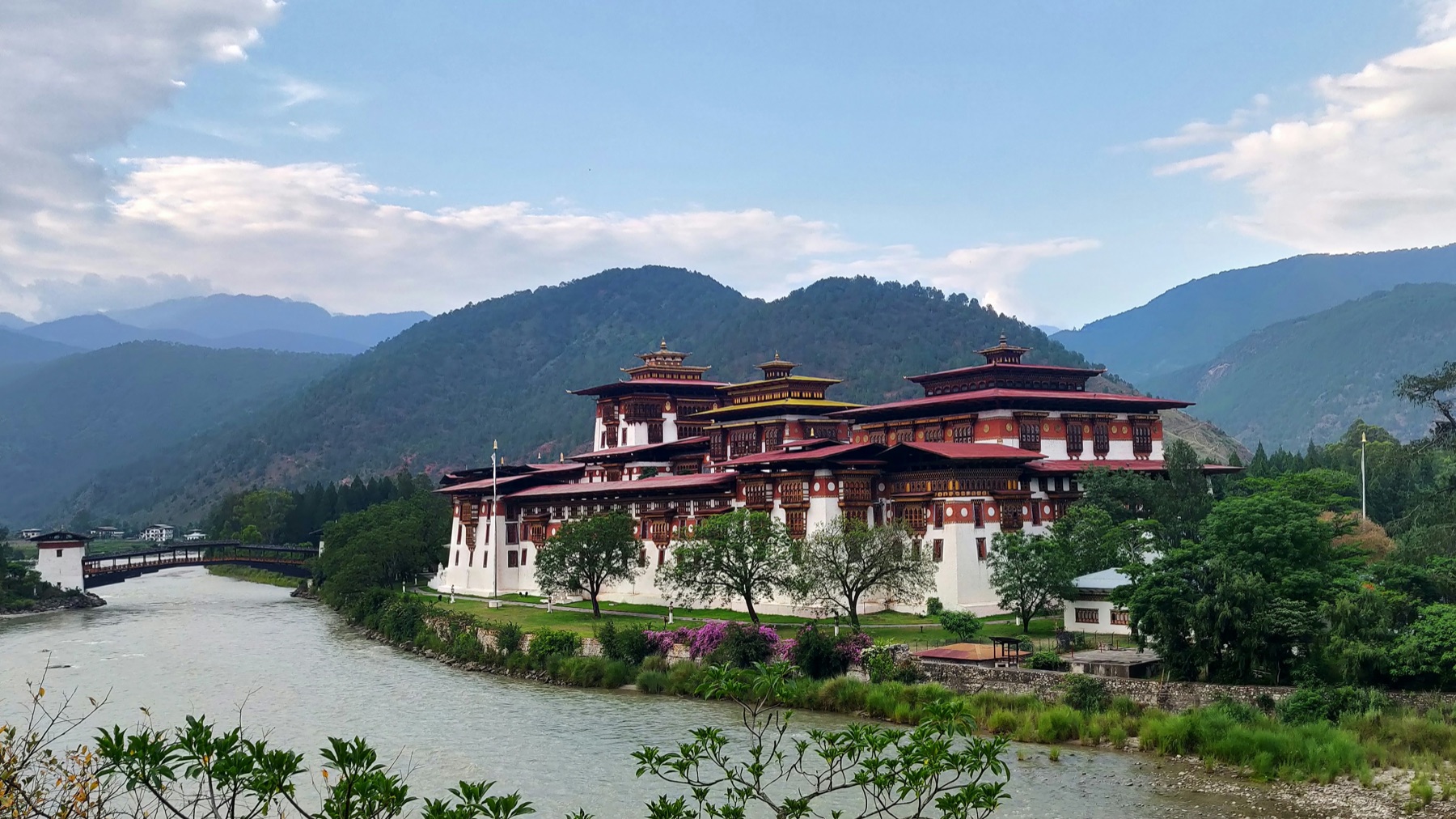
- Rinpung Dzong, the fortress guarding the approach to the valley
- The ruins of Drukgyel Dzong with Jomolhari framed behind them
- Kyichu Lhakhang, among the oldest temples in the kingdom
- A valley floor of terraced rice fields and traditional farmhouses
Things to Do
- Hike to Taktsang (Tiger's Nest) — a half-day round trip with a teahouse stop
- Tour the National Museum inside the round Ta Dzong watchtower
- Cycle or walk the flat valley roads between farmhouses
- Join a traditional hot-stone bath at a local farmhouse
- Browse handicraft shops along Paro's main street
Popular Places
Taktsang Monastery (Tiger's Nest)
Bhutan's most famous landmark, clinging to a cliff where Guru Rinpoche is said to have meditated after flying there on a tigress.
Rinpung Dzong
A working fortress-monastery with carved wooden galleries, still used for Paro's annual tshechu festival.
National Museum (Ta Dzong)
A former watchtower turned museum of Bhutanese art, textiles, and natural history overlooking Rinpung Dzong.
Drukgyel Dzong
Evocative ruins at the head of the valley, built to commemorate a 17th-century victory over Tibetan invaders.
Kyichu Lhakhang
One of Bhutan's oldest temples, said to be built in the 7th century to pin down a demoness across the Himalayas.
Mild for its elevation thanks to the sheltered valley. Summers are warm with monsoon showers; winters are cold but generally dry, with clear skies most days. Snow is possible at higher points on the Tiger's Nest trail between December and February, occasionally making the upper switchbacks icy.
Send us an enquiry — free itinerary customization.